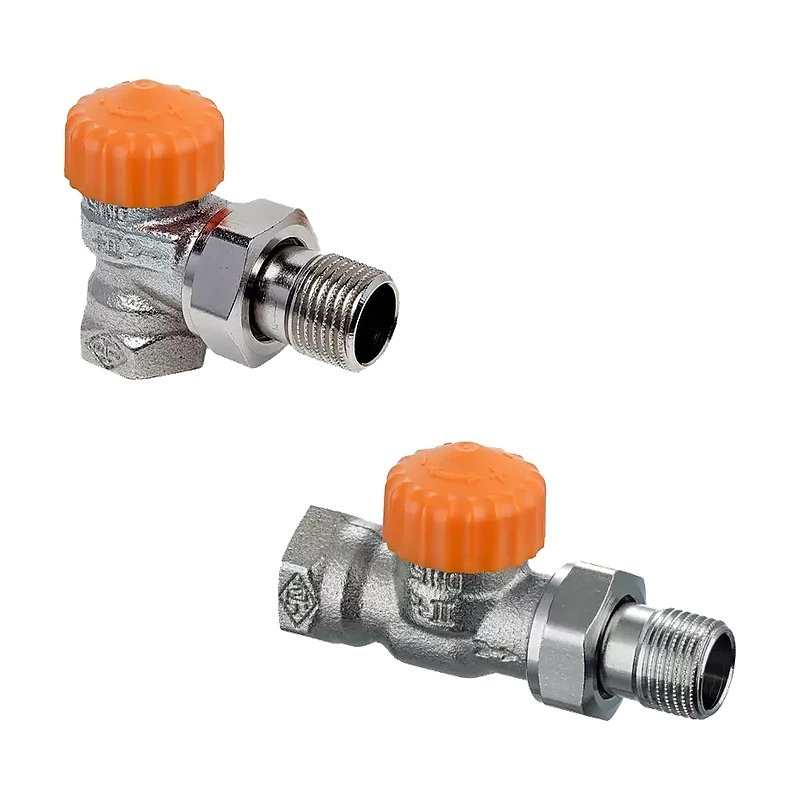
1. Danfoss vs. IMI Heimeier comparison
How to distinguish a Danfoss RA 23 mm spigot from an M30×1.5 thread in 10 seconds and order the right head?
Direct engineering answer:
The M30×1.5 standard uses a 30 mm threaded metal ring nut (1.5 mm pitch) compatible with IMI Heimeier, Oventrop, Honeywell, and Kermi valves. The Danfoss RA standard uses a 23 mm smooth neck with an annular groove ("Click" snap-lock without threads). The two standards are not interchangeable without an adapter.
| Criterion | Danfoss RA Click (23 mm) | Standard M30×1.5 (30 mm thread) | Recommendation |
|---|
| Valve neck diameter | ~23 mm smooth neck with annular groove | 30 mm external thread (1.5 mm pitch) | Measure with a ruler after removing the old head |
| Mounting method | Snap-on "Click" ring (tool-free) | Threaded metal nut (M30×1.5) | Mount with the head set to position "5" |
Valve neck diameter
Danfoss:~23 mm smooth neck with annular groove
IMI Heimeier:30 mm external thread (1.5 mm pitch)
Recommendation:Measure with a ruler after removing the old head
Mounting method
Danfoss:Snap-on "Click" ring (tool-free)
IMI Heimeier:Threaded metal nut (M30×1.5)
Recommendation:Mount with the head set to position "5"
2. IMI Heimeier vs. Danfoss comparison
Why does a standard Kv valve whistle during heating renovation and how does an automatic AFC valve solve it?
Direct engineering answer:
IMI Heimeier Eclipse with AFC (Automatic Flow Control) integrates a differential-pressure membrane so the target flow rate is set directly in liters per hour (10–150 L/h) and never exceeded even if system pressure spikes up to 60 kPa. A standard Kv valve (e.g. Danfoss RA-N) only restricts orifice area and requires full pipework pressure-drop calculations.
| Criterion | IMI Heimeier Eclipse (AFC) | Standard Kv Valve (RA-N / V-exact II) | Recommendation |
|---|
| Presetting principle | Directly in liters per hour (10–150 L/h by radiator kW) | Relative Kv scale (requires branch Δp calculation) | Eclipse AFC saves up to 70% commissioning time |
| Response when other radiators close | Membrane automatically absorbs excess pressure up to 60 kPa | Flow velocity rises across valve seat, causing whistling noise | Eclipse AFC guarantees silent operation |
Presetting principle
IMI Heimeier:Directly in liters per hour (10–150 L/h by radiator kW)
Danfoss:Relative Kv scale (requires branch Δp calculation)
Recommendation:Eclipse AFC saves up to 70% commissioning time
Response when other radiators close
IMI Heimeier:Membrane automatically absorbs excess pressure up to 60 kPa
Danfoss:Flow velocity rises across valve seat, causing whistling noise
Recommendation:Eclipse AFC guarantees silent operation
3. IMI Pneumatex vs. IMI Pneumatex comparison
Why can you never install a heating expansion vessel on a domestic hot water cylinder?
Direct engineering answer:
IMI Pneumatex Statico (PN3/PN6, 3–6 bar) is designed for closed hydronic heating circuits with deoxygenated water. IMI Pneumatex Aquapresso (PN10, 10 bar) features a stainless-steel/brass flow-through connection and hygienic food-grade Airproof butyl bladder required for potable DHW cylinders.
| Criterion | IMI Pneumatex Statico SD / SU (PN3 / PN6) | IMI Pneumatex Aquapresso AD / ADF (PN10) | Recommendation |
|---|
| Maximum working pressure | PN3 (3 bar) or PN6 (6 bar) | PN10 (10 bar – withstands mains water pressure surges) | DHW cylinders always require PN10 (Aquapresso) |
| Hygienic certification & corrosion protection | For closed deoxygenated heating water | Potable-grade bladder + stainless flow inlet against Legionella | Statico on a DHW line will corrode within 1–2 years |
Maximum working pressure
IMI Pneumatex:PN3 (3 bar) or PN6 (6 bar)
IMI Pneumatex:PN10 (10 bar – withstands mains water pressure surges)
Recommendation:DHW cylinders always require PN10 (Aquapresso)
Hygienic certification & corrosion protection
IMI Pneumatex:For closed deoxygenated heating water
IMI Pneumatex:Potable-grade bladder + stainless flow inlet against Legionella
Recommendation:Statico on a DHW line will corrode within 1–2 years
4. IMI Heimeier vs. Danfoss comparison
Why does adjusting one rotameter on a standard manifold throw off all neighboring floor loops?
Direct engineering answer:
On a traditional manifold with sight-glass rotameters, throttling one loop alters the pressure and flow across all adjacent loops. IMI Heimeier Dynacon Eclipse features built-in AFC automatic flow limiters (30–300 L/h): set each loop once in L/h and the flow stays constant.
| Criterion | IMI Heimeier Dynacon Eclipse (AFC) | Standard Manifold with Rotameters | Recommendation |
|---|
| Hydronic balancing | Automatic (AFC cartridge maintains set L/h flow independently) | Manual (adjusting one loop shifts flow in other loops) | Dynacon Eclipse saves 3–4 hours of balancing work |
| Operation with zone actuators | Remaining open loops never receive excess flow when rooms close | Flow spikes in open loops, potentially causing valve noise | Dynacon Eclipse is superior for multi-zone control |
Hydronic balancing
IMI Heimeier:Automatic (AFC cartridge maintains set L/h flow independently)
Danfoss:Manual (adjusting one loop shifts flow in other loops)
Recommendation:Dynacon Eclipse saves 3–4 hours of balancing work
Operation with zone actuators
IMI Heimeier:Remaining open loops never receive excess flow when rooms close
Danfoss:Flow spikes in open loops, potentially causing valve noise
Recommendation:Dynacon Eclipse is superior for multi-zone control
5. IMI Heimeier vs. Danfoss comparison
How to match thermal actuator voltage and thread to your wiring center and manifold?
Direct engineering answer:
Thermal actuator voltage (230 V AC or 24 V AC/DC) must match the wiring center output 1:1: connecting a 24 V actuator to 230 V burns out its wax element in seconds. NC (Normally Closed) keeps the loop closed when de-energized (used in 95% of residential systems).
| Criterion | 230 V NC Thermal Actuator (EMO T / TWA 230V) | 24 V NC Thermal Actuator (Danfoss TWA / EMO T 24V) | Recommendation |
|---|
| Supply voltage | 230 V AC (directly from 230 V controller relay) | 24 V AC/DC (requires 24 V controller / transformer) | Check the rating label inside your wiring box |
| Operating logic (NC vs NO) | NC = closed without power (95% of residential systems) | NO = open without power (special building automation only) | Choose NC unless specified otherwise |
Supply voltage
IMI Heimeier:230 V AC (directly from 230 V controller relay)
Danfoss:24 V AC/DC (requires 24 V controller / transformer)
Recommendation:Check the rating label inside your wiring box
Operating logic (NC vs NO)
IMI Heimeier:NC = closed without power (95% of residential systems)
Danfoss:NO = open without power (special building automation only)
Recommendation:Choose NC unless specified otherwise
6. IMI TA vs. IMI TA comparison
When is a manual IMI TA STAD balancing valve sufficient and when do you need a differential pressure controller?
Direct engineering answer:
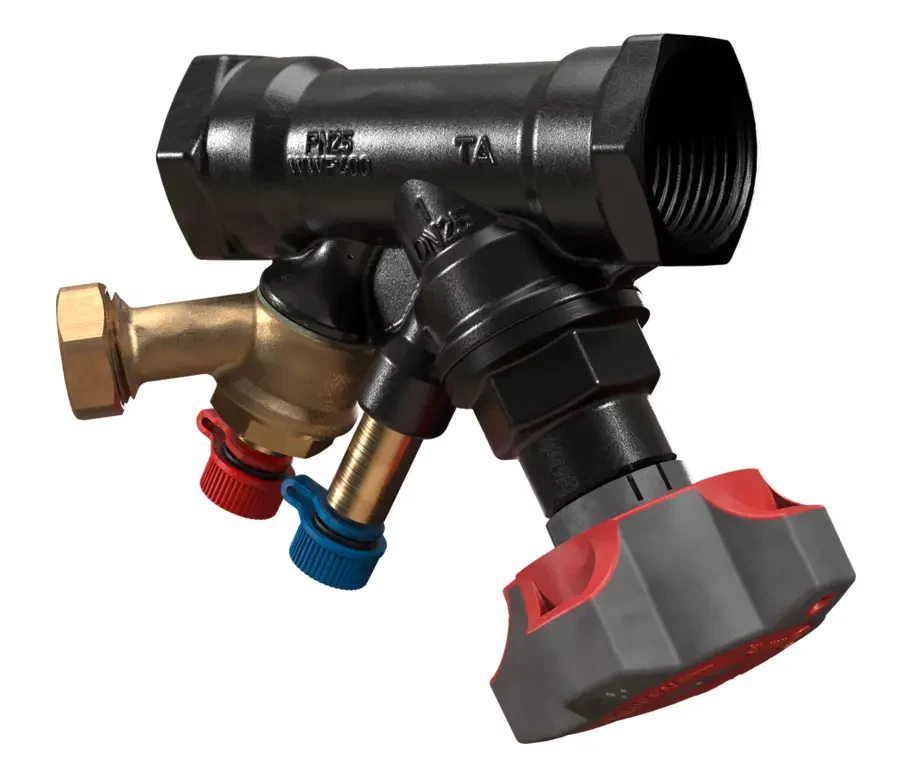
IMI TA STAD (DN15–DN50) is a precision manual balancing valve with a 4-turn digital handwheel, memory stop, and P/T test points for constant-flow branches. Automatic valves (TA-Modulator / PIBCV, Danfoss ASV-PV) dynamically stabilize differential pressure Δp in variable-flow systems.
| Criterion | IMI TA STAD (DN15–DN50) | IMI TA-Modulator / TBV-C / Danfoss ASV | Recommendation |
|---|
| Control type | Static precision Kv locking with P/T measuring nipples | Dynamic automatic Δp and flow stabilization | STAD for boiler branches/risers; PIBCV for dynamic zones |
| Heat pump sizing (ΔT = 5 K) | Easy DN20–DN32 selection for low pressure drop (Δp = 3–8 kPa) | Precision modulating flow limitation with actuator | Upsize by 1 DN step for heat pump primary loops |
Control type
IMI TA:Static precision Kv locking with P/T measuring nipples
IMI TA:Dynamic automatic Δp and flow stabilization
Recommendation:STAD for boiler branches/risers; PIBCV for dynamic zones
Heat pump sizing (ΔT = 5 K)
IMI TA:Easy DN20–DN32 selection for low pressure drop (Δp = 3–8 kPa)
IMI TA:Precision modulating flow limitation with actuator
Recommendation:Upsize by 1 DN step for heat pump primary loops
7. IMI Pneumatex vs. IMI Heimeier comparison
Why do radiators gurgle again a week after bleeding and why do float vents start leaking?
Direct engineering answer:
A standard float air vent only releases large free air pockets at high points and often clogs with black magnetite sludge (Fe3O4). IMI Pneumatex Zeparo with Helistill rings and a neodymium magnet installs inline: it extracts dissolved microbubbles and traps magnetite before it reaches the pump.
| Criterion | IMI Pneumatex Zeparo (ZUV / ZUKM / ZUD) | Standard Float Air Vent (3/8"–1/2") | Recommendation |
|---|
| Air removed | Free air + dissolved microbubbles (vacuum absorption) | Only large free air pockets at the highest point | Zeparo deaerates the system within days without manual bleeding |
| Protection against black magnetite sludge (Fe3O4) | Helistill rings + neodymium magnet capture iron oxide | Sludge fouls the float seat and causes vent weeping | Zeparo extends ECM pump and valve service life |
Air removed
IMI Pneumatex:Free air + dissolved microbubbles (vacuum absorption)
IMI Heimeier:Only large free air pockets at the highest point
Recommendation:Zeparo deaerates the system within days without manual bleeding
Protection against black magnetite sludge (Fe3O4)
IMI Pneumatex:Helistill rings + neodymium magnet capture iron oxide
IMI Heimeier:Sludge fouls the float seat and causes vent weeping
Recommendation:Zeparo extends ECM pump and valve service life
8. IMI Heimeier vs. IMI Heimeier comparison
Which H-block valve, Eurokonus compression fittings, and thermostatic head fit a bottom or side radiator?
Direct engineering answer:
Bottom-connection (VK – Ventil Kompakt) radiators have two bottom ports spaced 50 mm apart and a factory-installed upper valve insert, requiring a 50 mm H-block (straight from floor or angled from wall) plus a thermostatic head. Side-connection radiators (DN15 1/2") require two separate valves: a thermostatic supply valve on top and a lockshield return valve at the bottom.
| Criterion | Bottom VK 50 mm Connection (Multilux / Vekolux H-block) | Side DN15 (1/2") Connection (Eclipse + Regulux) | Recommendation |
|---|
| Pipe center distance & port thread | 50 mm center-to-center at radiator bottom (G 3/4" Eurokonus / G 1/2") | Side top and bottom ports (female thread G 1/2" DN15) | VK radiator = 50 mm H-block; side radiator = 2 separate valves |
| Pipes from wall vs. from floor | From wall = angled H-block; from floor = straight H-block | Angled or straight thermostatic valve matching pipe entry | Do not mix up angled and straight H-blocks! |
Pipe center distance & port thread
IMI Heimeier:50 mm center-to-center at radiator bottom (G 3/4" Eurokonus / G 1/2")
IMI Heimeier:Side top and bottom ports (female thread G 1/2" DN15)
Recommendation:VK radiator = 50 mm H-block; side radiator = 2 separate valves
Pipes from wall vs. from floor
IMI Heimeier:From wall = angled H-block; from floor = straight H-block
IMI Heimeier:Angled or straight thermostatic valve matching pipe entry
Recommendation:Do not mix up angled and straight H-blocks!
9. IMI Pneumatex vs. IMI Heimeier comparison
How to tell by hand in 15 seconds whether your radiator is air-locked or choked with black magnetite sludge?
Direct engineering answer:
If the top of the radiator is cold while the bottom is warm, free air has collected at the top – bleed it via the air vent. If the top is hot while the bottom center remains cold, black iron-oxide sludge (magnetite Fe3O4) has settled at the bottom – flush the radiator and install an IMI Pneumatex Zeparo magnetic separator.
| Criterion | IMI Pneumatex Zeparo ZUKM / ZUVS Magnetic Separator | IMI Heimeier Radiator Bleeding & Balancing Valve | Recommendation |
|---|
| Temperature symptom on radiator panel | Bottom center cold, top hot, dark water when drained | Top cold, gurgling sound, clear water | Cold bottom = magnetite sludge; cold top = air pocket |
| Permanent engineering solution | Flush radiator + install inline magnetic dirt separator Zeparo | Bleed radiator + install microbubble air separator on supply line | Protect ECM pumps against magnetic iron oxide |
Temperature symptom on radiator panel
IMI Pneumatex:Bottom center cold, top hot, dark water when drained
IMI Heimeier:Top cold, gurgling sound, clear water
Recommendation:Cold bottom = magnetite sludge; cold top = air pocket
Permanent engineering solution
IMI Pneumatex:Flush radiator + install inline magnetic dirt separator Zeparo
IMI Heimeier:Bleed radiator + install microbubble air separator on supply line
Recommendation:Protect ECM pumps against magnetic iron oxide
10. Danfoss vs. IMI Heimeier comparison
Why does a radiator behind heavy curtains or a deep windowsill shut off while the room is still cold?
Direct engineering answer:
A standard built-in sensor head measures the trapped warm air pocket right next to the valve under the windowsill, closing prematurely at 22 °C while the room is still 18 °C. A thermostatic head with a 2 m remote capillary bulb (or wall transmitter) measures true room temperature on an open wall.
| Criterion | Head with 2 m Capillary Remote Sensor (Heimeier K / Danfoss) | Standard Built-In Liquid/Gas Sensor Head | Recommendation |
|---|
| Temperature measurement point | On open wall up to 2 m away from heat pocket | Directly at radiator valve neck | Use remote sensor whenever radiator is covered or vertical |
| Vertical installation attitude | Accurate in any valve orientation | Must be mounted horizontally so rising heat does not fool sensor | Vertical valve mounting requires a remote sensor |
Temperature measurement point
Danfoss:On open wall up to 2 m away from heat pocket
IMI Heimeier:Directly at radiator valve neck
Recommendation:Use remote sensor whenever radiator is covered or vertical
Vertical installation attitude
Danfoss:Accurate in any valve orientation
IMI Heimeier:Must be mounted horizontally so rising heat does not fool sensor
Recommendation:Vertical valve mounting requires a remote sensor
11. IMI Heimeier vs. IMI Heimeier comparison
When can you connect a small bathroom floor loop with an RTL box and when do you need a pump mixing station?
Direct engineering answer:
An RTL box (IMI Heimeier Multibox K-RTL) is suitable only for single small rooms up to 15–20 m² (1 loop max 80 m) fed from a radiator circuit. For multiple rooms or areas above 20 m², a dedicated thermostatic mixing valve and circulation pump group (35–45 °C supply) is mandatory so floor screed never overheats.
| Criterion | Thermostatic Mixing Pump Group (35–45 °C) | IMI Heimeier Multibox K-RTL (up to 15–20 m²) | Recommendation |
|---|
| Maximum heated floor area | 20 m² to 250 m² (2 to 12 manifold loops) | Up to 15–20 m² (1 loop, max pipe length 70–80 m) | Multibox RTL for 1 bathroom; mixing group for 2+ loops |
| Supply water temperature control | Mixes supply down to safe 35–45 °C before entering floor | Limits return temperature at loop exit (40–50 °C) | Full floor areas require supply mixing protection |
Maximum heated floor area
IMI Heimeier:20 m² to 250 m² (2 to 12 manifold loops)
IMI Heimeier:Up to 15–20 m² (1 loop, max pipe length 70–80 m)
Recommendation:Multibox RTL for 1 bathroom; mixing group for 2+ loops
Supply water temperature control
IMI Heimeier:Mixes supply down to safe 35–45 °C before entering floor
IMI Heimeier:Limits return temperature at loop exit (40–50 °C)
Recommendation:Full floor areas require supply mixing protection
12. IMI Heimeier vs. IMI Pneumatex comparison
Why stays an underfloor loop stuck at 0 L/min even with an automatic air vent on the manifold bar?
Direct engineering answer:
A manifold end-cap air vent only bleeds air that reaches the header bar; it cannot push an airlock out of an 80-meter horizontal floor pipe. Airlocked loops must be purged one loop at a time using fill/drain valves with mains water pressure, then maintained with Dynacon Eclipse AFC.
| Criterion | IMI Heimeier Dynacon Eclipse Manifold with Fill/Drain Kit | Manifold Automatic End-Cap Air Vent 1/2" | Recommendation |
|---|
| Removing airlocks from 80 m floor loops | Purge one loop at a time with all other loops closed | Vents air only inside the top manifold header bar | Initial commissioning requires loop-by-loop flushing |
| Flowmeter visibility over time | AFC cartridge regulates flow even if water darkens | Sight glasses can cloud with magnetite without a separator | Combine Dynacon Eclipse with a Zeparo separator |
Removing airlocks from 80 m floor loops
IMI Heimeier:Purge one loop at a time with all other loops closed
IMI Pneumatex:Vents air only inside the top manifold header bar
Recommendation:Initial commissioning requires loop-by-loop flushing
Flowmeter visibility over time
IMI Heimeier:AFC cartridge regulates flow even if water darkens
IMI Pneumatex:Sight glasses can cloud with magnetite without a separator
Recommendation:Combine Dynacon Eclipse with a Zeparo separator
13. IMI Pneumatex vs. IMI Pneumatex comparison
How to test the Schrader valve on your expansion vessel and know whether to pump air or replace the tank?
Direct engineering answer:
Briefly press the air Schrader valve on the expansion vessel: if water squirts out, the bladder is ruptured and the vessel must be replaced with an IMI Pneumatex Statico SD. If only air hisses out, isolate the vessel from system water (0 bar water side) and pump P0 = H_stat/10 + 0.2 bar.
| Criterion | Replace with IMI Pneumatex Statico SD (Airproof butyl bladder) | Recharge Air Cushion P0 via DLV Service Lockshield Valve | Recommendation |
|---|
| Schrader air nipple test result | Water comes out of air nipple = ruptured bladder | Dry air comes out, pressure below 0.8 bar = lost pre-charge | Water at air valve means mandatory vessel replacement |
| Correct P0 measurement condition | Pre-set P0 before connecting new vessel to water pipe | Close DLV service valve and drain water side to 0 bar first | Never measure P0 while system water pressure is applied |
Schrader air nipple test result
IMI Pneumatex:Water comes out of air nipple = ruptured bladder
IMI Pneumatex:Dry air comes out, pressure below 0.8 bar = lost pre-charge
Recommendation:Water at air valve means mandatory vessel replacement
Correct P0 measurement condition
IMI Pneumatex:Pre-set P0 before connecting new vessel to water pipe
IMI Pneumatex:Close DLV service valve and drain water side to 0 bar first
Recommendation:Never measure P0 while system water pressure is applied
14. IMI Pneumatex vs. IMI Pneumatex comparison
Why does the safety valve on your hot water cylinder drip every time water heats up?
Direct engineering answer:
When cold potable water heats from 10 °C to 60 °C inside a 200 L cylinder with a check valve on the inlet, water volume expands by ~3–4 liters. Without a PN10 potable expansion vessel (IMI Pneumatex Aquapresso AD), pressure hits 6–8 bar and the safety valve discharges water.
| Criterion | IMI Pneumatex Aquapresso AD (PN10 Potable Expansion Vessel) | Inline Water Hammer Arrestor for Quick-Closing Taps | Recommendation |
|---|
| Primary function | Absorbs thermal volume expansion during DHW cylinder heating | Dampens momentary pressure spikes when solenoid/lever taps slam shut | Dripping boiler relief valve requires Aquapresso AD (6–8% of cylinder L) |
| Pre-charge pressure P0 setting | 0.2 bar below cold water pressure reducing valve (e.g. 3.8 bar) | Factory-charged compact damper near washing machine/tap manifold | Set Aquapresso P0 to match cold water mains reducer |
Primary function
IMI Pneumatex:Absorbs thermal volume expansion during DHW cylinder heating
IMI Pneumatex:Dampens momentary pressure spikes when solenoid/lever taps slam shut
Recommendation:Dripping boiler relief valve requires Aquapresso AD (6–8% of cylinder L)
Pre-charge pressure P0 setting
IMI Pneumatex:0.2 bar below cold water pressure reducing valve (e.g. 3.8 bar)
IMI Pneumatex:Factory-charged compact damper near washing machine/tap manifold
Recommendation:Set Aquapresso P0 to match cold water mains reducer
15. IMI TA vs. IMI TA comparison
Why does an air-to-water heat pump need 3× higher flow rate than a boiler and a Gorenje ZV 100 buffer tank?
Direct engineering answer:
A heat pump operates at a narrow temperature delta (ΔT = 5 K), requiring 1,720 L/h of water flow for 10 kW (3× more than a boiler at ΔT = 15 K). Adding a 100 L buffer tank (Gorenje ZV 100) and DN25–DN32 piping prevents compressor short-cycling and supplies energy for defrost.
| Criterion | Heat Pump Hydraulics (ΔT = 5 K + Gorenje ZV 100 Buffer) | Boiler Hydraulics (ΔT = 15–20 K) | Recommendation |
|---|
| Required flow rate for 10 kW output | ~1,720 L/h (requires DN25 / 1" primary piping) | ~573 L/h (DN15–DN20 piping is sufficient) | Never choke a heat pump with narrow DN15 primary pipes |
| Defrost & anti-short-cycling buffer | 10–15 L per kW (Gorenje ZV 100 for 8–10 kW heat pump) | Not required for modulating gas boilers | ZV 100 protects the compressor when room actuators close |
Required flow rate for 10 kW output
IMI TA:~1,720 L/h (requires DN25 / 1" primary piping)
IMI TA:~573 L/h (DN15–DN20 piping is sufficient)
Recommendation:Never choke a heat pump with narrow DN15 primary pipes
Defrost & anti-short-cycling buffer
IMI TA:10–15 L per kW (Gorenje ZV 100 for 8–10 kW heat pump)
IMI TA:Not required for modulating gas boilers
Recommendation:ZV 100 protects the compressor when room actuators close
16. IMI Pneumatex vs. IMI Heimeier comparison
Why does a standard mesh Y-strainer fail to stop fine magnetite and choke heat pump flow?
Direct engineering answer:
A brass mesh Y-strainer (400–500 micron screen) catches only coarse sand/hemp while letting 5–50 micron magnetic iron oxide pass straight into the wet-rotor ECM pump, and as its screen clogs it creates severe pressure drop. A cyclonic magnetic separator traps micro-magnetite with minimal hydraulic resistance.
| Criterion | IMI Pneumatex Zeparo ZUKM / ZUVS Magnetic Separator | Standard Brass Mesh Y-Strainer | Recommendation |
|---|
| Magnetite particle capture (5–50 microns) | Neodymium magnet + cyclonic chamber captures fine Fe3O4 | Passes through 500 µm mesh directly into pump rotor | ECM pumps and heat pumps require a magnetic separator |
| Hydraulic pressure loss over time | Constant low Δp – dirt settles into bottom collection bowl | Mesh clogs in flow path and starves heat pump of flow | Flush Zeparo in 10 seconds via bottom drain valve |
Magnetite particle capture (5–50 microns)
IMI Pneumatex:Neodymium magnet + cyclonic chamber captures fine Fe3O4
IMI Heimeier:Passes through 500 µm mesh directly into pump rotor
Recommendation:ECM pumps and heat pumps require a magnetic separator
Hydraulic pressure loss over time
IMI Pneumatex:Constant low Δp – dirt settles into bottom collection bowl
IMI Heimeier:Mesh clogs in flow path and starves heat pump of flow
Recommendation:Flush Zeparo in 10 seconds via bottom drain valve
17. IMI TA vs. IMI Heimeier comparison
Why does partially closing a ball valve on the first floor fail to balance heating risers?
Direct engineering answer:
A quarter-turn ball valve is an shut-off device with a non-linear characteristic: throttling it creates cavitation noise, erodes the Teflon seal, and has no repeatable scale. An IMI TA STAD balancing valve provides 4 full turns of linear Kv adjustment, P/T measuring nipples, and a memory stop.
| Criterion | IMI TA STAD Precision Riser Balancing Valve | Quarter-Turn Shut-Off Ball Valve | Recommendation |
|---|
| Flow adjustment precision | 4 full turns (40 graduation steps) + digital readout | 90° lever – flow only changes in the last 15° of travel | Use STAD on every floor branch or riser return |
| Repeatability after maintenance shut-off | Internal Memory Stop restores exact setting after closing | Setting is lost whenever the lever is moved | Memory Stop preserves multi-floor hydraulic balance |
Flow adjustment precision
IMI TA:4 full turns (40 graduation steps) + digital readout
IMI Heimeier:90° lever – flow only changes in the last 15° of travel
Recommendation:Use STAD on every floor branch or riser return
Repeatability after maintenance shut-off
IMI TA:Internal Memory Stop restores exact setting after closing
IMI Heimeier:Setting is lost whenever the lever is moved
Recommendation:Memory Stop preserves multi-floor hydraulic balance
18. IMI Heimeier vs. IMI Heimeier comparison
Why does a manifold Eurokonus joint stay dry when hot but start dripping overnight when the system cools?
Direct engineering answer:
Multilayer PEX-AL-PEX 16×2.0 mm pipe cut with shears becomes slightly oval and has a sharp inner aluminum burr. Pushing it onto a 3/4" Eurokonus insert without a beveling calibrator slices the rubber O-ring, which then leaks whenever the pipe contracts during night setback.
| Criterion | Comisa 3/4" × 16×2.0 Eurokonus with Beveled Pipe Calibration | Uncalibrated Pipe Assembly / Mismatched Wall Thickness | Recommendation |
|---|
| Pipe wall dimension matching | Exact 16×2.0 mm insert (12.0 mm inner bore) | 16×2.2 or 17×2.0 insert mismatch causes loose grip or split pipe | Match Eurokonus insert 1:1 to pipe outer diameter and wall thickness |
| O-ring seal integrity during thermal cycling | Calibrator chamfers inner edge so O-rings slide in intact | Sharp aluminum edge nicks O-ring, causing cold-water weeping | Always calibrate and bevel PEX-AL-PEX before inserting |
Pipe wall dimension matching
IMI Heimeier:Exact 16×2.0 mm insert (12.0 mm inner bore)
IMI Heimeier:16×2.2 or 17×2.0 insert mismatch causes loose grip or split pipe
Recommendation:Match Eurokonus insert 1:1 to pipe outer diameter and wall thickness
O-ring seal integrity during thermal cycling
IMI Heimeier:Calibrator chamfers inner edge so O-rings slide in intact
IMI Heimeier:Sharp aluminum edge nicks O-ring, causing cold-water weeping
Recommendation:Always calibrate and bevel PEX-AL-PEX before inserting
19. IMI Heimeier vs. Ferroli comparison
Can you heat an existing house with radiators using a heat pump without ripping up floors?
Direct engineering answer:
Yes: a natural-refrigerant R290 propane heat pump (Haier Super Aqua AW082HUGHA / AW102HUGHA) delivers supply water up to +75 °C even in sub-zero frost, matching cast-iron and steel radiator requirements, provided radiator valves are upgraded to high-flow IMI Heimeier Eclipse AFC.
| Criterion | Haier Super Aqua R290 Monoblock (up to +75 °C flow) | Standard R32 Low-Temperature Heat Pump (up to +55 °C flow) | Recommendation |
|---|
| Maximum supply water temperature T1 | Up to +75 °C (compatible with existing radiator systems) | Up to +55 °C (best suited for underfloor heating) | For existing radiators choose R290 propane technology |
| Required radiator valve upgrade | IMI Heimeier Eclipse AFC set to ΔT = 5–7 K flow rate | Requires oversized low-temperature convectors | Balance radiator flows with Eclipse AFC + Gorenje ZV 100 buffer |
Maximum supply water temperature T1
IMI Heimeier:Up to +75 °C (compatible with existing radiator systems)
Ferroli:Up to +55 °C (best suited for underfloor heating)
Recommendation:For existing radiators choose R290 propane technology
Required radiator valve upgrade
IMI Heimeier:IMI Heimeier Eclipse AFC set to ΔT = 5–7 K flow rate
Ferroli:Requires oversized low-temperature convectors
Recommendation:Balance radiator flows with Eclipse AFC + Gorenje ZV 100 buffer
20. Danfoss vs. IMI Heimeier comparison
When is a floor slab NTC sensor mandatory and how to size the manifold cabinet for your wiring center?
Direct engineering answer:
A dual-sensor room thermostat (air + floor NTC probe in conduit) is mandatory for wood/parquet floors (limiting slab temperature to <= 27 °C) and bathrooms (keeping tiles warm at >= 24 °C even when air is warm). Size the manifold cabinet 100–150 mm wider when housing a multi-zone wiring controller.
| Criterion | Digital Room Thermostat with Floor NTC Probe (Danfoss Icon / Watts) | Standard Air-Only Room Thermostat | Recommendation |
|---|
| Parquet / hardwood floor protection (max 27 °C) | Floor NTC sensor limits screed temperature to <= 27 °C | Measures air only – sun or heat spikes can overheat wood | Always install a floor sensor conduit for wood and bathroom tiles |
| Manifold cabinet width selection | Add +120 mm cabinet width for multi-zone wiring center | Standard cabinet fits manifold bars only | Choose a cabinet 1 size wider when installing zone automation |
Parquet / hardwood floor protection (max 27 °C)
Danfoss:Floor NTC sensor limits screed temperature to <= 27 °C
IMI Heimeier:Measures air only – sun or heat spikes can overheat wood
Recommendation:Always install a floor sensor conduit for wood and bathroom tiles
Manifold cabinet width selection
Danfoss:Add +120 mm cabinet width for multi-zone wiring center
IMI Heimeier:Standard cabinet fits manifold bars only
Recommendation:Choose a cabinet 1 size wider when installing zone automation